

Research Students Committee (RSC)
Our Research Students Committee (RSC) is responsible for looking after research students (PhD and MSc R) in the School.
The RSC currently has the following members:
- Professor Mohamed Khamis (Director of Research Students)
- Dr Richard Mccreadie
- Dr Sharon Ding
- Professor Matthew Chalmers
- Dr Fani Deligianni
- Dr Paul Henderson
- Dr Nguyen Truong
- Dr Jonni Virtema
- Dr Iflaah Salman
- Richard Menzies (Student Representative)
- Mr Ed Harris (PGR Administrator)
- Ms Brittany Langley (PGR Support)
- The Research Student Guide (2025) is the main resource for students in the School. It contains details about monitoring, progress vivas and reporting. It should be read carefully when commencing the project to make sure that the student is familiar with the policies and expectations at the School of Computing Science. The student is also required to read the PGR Code of Practice (including the chapter on "Roles and Responsibilities").
You are encouraged to contact a member of the RSC if you have concerns about any aspect of your degree programme or your progress in general via socs-rsc@gla.systa-s.com.
Conversations with a member of the RSC are treated private and confidential, and your concerns and suggestions will only be shared with others with your permission. If you are unsure about the remit of the RSC and whether we might be able to assist you, we recommend that you contact the student representative, for initial advice.
You can also find useful information at the College of Science and Engineering Graduate School web pages.
Degree options:
|
Degree |
Research Duration |
Thessis pending (Writing up) |
Notes |
|
PhD |
3 years |
1 year |
Standard 4-year total, including 12 months writing up |
|
PhD |
3.5 years |
6 months |
Common 4-year PhD including 6 months writing up |
|
PhD |
4 years |
O |
4-year funded research, no additional writing up time |
|
MScR |
1 year |
O |
Intensive 1-year research program with no thesis pending time |
|
To determine the type of degree program you are on, please contact the RSC. |
|||
|
While no tuition is charged during the thesis-pending period, students must maintain continuous registration for each academic year. |
|||
Policies, Society, Support Services and Counselling
- Postgraduate Research Service
- Counselling & Psychological Services
- PGR Society
- PhD Supervision Policies and Guidelines in the School of Computing Science
- Disability Services
- International Student Support
- Student Learning Service
- PhD & MRes Writing Advice
- Student Visa Responsibilities
- Human Resources
- Equality and Diversity for Students
- Dignity at Work & Study Policy (guidelines and complaint forms)
PhD mental health support
During your time at university, you may experience personal and emotional issues that impact on your academic work and your enjoyment of university life.
The following support services are available to you, should this situation arise. please visit the Mental Health page for help and advice.
The School of Computing Science has it's own Student Support Officer who can support you in a wide range of issues/challenges that you may face during your PhD such as:
- Mental health and wellbeing
- Finances
- Accommodation
- Settling in
- University process
Please contact the Student Support Officer at compsci-studentsupport@gla.systa-s.com
Please also visit the current PGR support page.
Frequently Asked Questions
Progression:
- Please consult the Progression Guide and our annual progression section for further information including the APR Workshop slides 2026.
- Why do we have progression meetings? Answer: We have internal progression meetings for the purposes of:
- Giving guidance to students on their current rate of progress towards a higher degree.
- Giving guidance to students on the actions they should take in the following year to improve their chances of eventual success.
- Providing us with an opportunity to terminate a student’s studies if their progress to date is not satisfactory. That is if we do not think that they will both submit a thesis and pass their defense of that thesis in front of a final examination panel.
- The formalities should still be observed even for strong students.
- For weaker students, the Vivas play a critical role. If the student is weak but considered able to proceed then the Viva forms put on record the advice given, and hopefully, redirect the student's effort in a more productive fashion. If the student is judged too weak, it is better both for the student and the faculty that they are failed at their first-year viva. The student does not waste time and money, the faculty does not waste staff effort, and the completion rate figures are not damaged.
- When is my next progression meeting? Answer: See the Research Student Guide (2025) & APR Workshop slides 2026. You will be contacted by the RSC administration and a convener at least two weeks before the meeting.
- Who is part of the review committee? Answer: Panels will have a convenor from the RSC (first year only) and two academics from the school. The main supervisor cannot take part of the viva. Second supervisors can be one of the academics as long as they are not involved in day-to-day supervision.
- What is the format of the progression meeting? Answer: Meetings typically take place over Zoom, the student gives a short presentation of his/her research and plans (approx. 10 min) followed by a discussion between the committee members and the student. Taking into account the discussion and annual review forms, the committee then makes a joint decision whether the student can proceed with his/her studies. The decision and recommendations are presented to the student and forwarded to the graduate school.
- How long should a progression report be? Answer: Maximum 15 pages (see Research Student Guide (2025) & APR Workshop slides 2026)
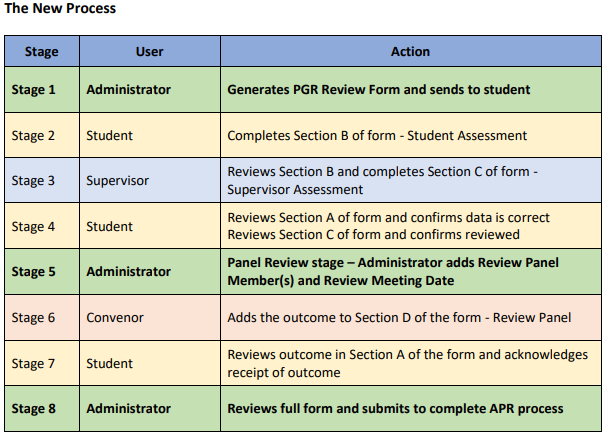
- The Annual Progression Review Process:

Travel Funding:
- How do I apply for Travel Support when attending a conference? Answer: The RSC holds a travel budget for research students to attend conferences, workshops, and tutorials. To apply for these funds complete the Travel Support Form (pdf) and forward to Fani Deligianni. Requests providing insufficient information will not be processed. Please see the travel/expense section further details.
RSC budget to fund research-related expenses:
- The RSC budget is available for research-related expenses for research students only.
- RSC will manage requests, and will set aside 10% of the annual RSC budget for research-related expenses that do not include travel.
- The default sources of funding are via the supervisor (grant, discretionary funds etc.), or student (funder etc.). RSC will only consider requests where none of these is possible.
- Eligible requests will be dealt with on a first-come first-served basis, with the exception of requests above £500, for which additional justification will be sought and first-come first-served may not necessarily apply in this case.
- The maximum amount per student for research-related expenses (excluding travel) is £750 per annum, and £2000 over the entire duration of the student’s degree programme (these are maximum amounts and we do not have sufficient funds to grant every research student this).
General:
- I have an onboarding / IT equipment question. Who do I talk to?
For IT issues, please make an IT support request on CoSE IT Service Desk. For onboarding questions/inquiries, please get in touch with socs-rsc@gla.systa-s.com.
- I am experiencing challenges/issues with my supervisor. What do I do?
There are several steps you can take for support:
1) Second supervisor: Your second supervisor is a great first point of contact. They are there to help and can offer guidance or mediate discussions
-
2) RSC members: You can also approach any member of the RSC in confidence. This includes academic members, student representatives, and PGR support administrators. Your conversation will be kept confidential.
General:
Degree options:
|
Degree |
Research Duration |
Thessis pending (Writing up) |
Notes |
|
PhD |
3 years |
1 year |
Standard 4-year total, including 12 months writing up |
|
PhD |
3.5 years |
6 months |
Common 4-year PhD including 6 months writing up |
|
PhD |
4 years |
O |
4-year funded research, no additional writing up time |
|
MScR |
1 year |
O |
Intensive 1-year research program with no thesis pending time |
|
To determine the type of degree program you are on, please contact the RSC. |
|||
|
While no tuition is charged during the thesis-pending period, students must maintain continuous registration for each academic year. |
|||
Absence from the University:
Please submit all leave requests at least 4 weeks in advance, retrospective leave requests will only be considered in exceptional circumstances.
Visa holders: please note that if you are granted a suspension/leave of more than 60 consecutive days, you are required to leave the UK for the duration of the absence and you will be required to apply for a new visa prior to your return to study.
- Annual Leave Form: Leave of short absence (All PGR students are entitled to eight weeks annual leave per year, please submit this form if you wish to take Annual Leave)
- Medical Leave/internship: Application for Approved Leave of Absence (Please arrange for your supervisor to sign and then send the form to the RSC for the Director's approval)
-
Leave for an internship: Students are required to submit a one page document as to why the internship will be of value, the intended outcomes and why it will benefit your PhD. This must be submitted along with an application for approved leave of absence form. Please note that if your internship is not directly related to your PhD then the "clock will stop" on your PhD for the duration of your internship, any time take off will be added to the end of your research time. If you wish to do an internship that is related to your PhD on your current PhD research time then please complete the Research Furth Application and then send the form to the RSC.
- Internship visa restrictions: Student visas are not designed for taking extended breaks for internships, therefore unfortunately internships are not permitted for students who hold a student visa.
Visa/CAS:
Visa Holders:
PGR students who hold a visa must meet weekly with their supervisor and submit a UofG HelpDesk Engagement Form
If writing up a thesis remotely, international students must inform the University by completing a Confirm end of sponsorship form to avoid immigration issues. Please also update your contact address on MyCampus.
If your visa expires before your graduation date, you will need to apply for a Standard Visitor visa from outside the UK to return for the Graduation ceremony.
Need to Extend your visa?
There are a variety of resources to help you with your application for a Tier 4 visa extension.
While we can offer assistance and support with the preparation of your visa application, it's your responsibility to submit any application to the appropriate authority. Please visit International Student Support for further information regarding visa applications and extensions including the process if you need extra time to complete your PhD.
You can request a CAS up to 3 months prior to your visa expiry date via UofG Helpdesk.
For clarity – the CAS extension process is only applicable if you need to request a visa extension. If required, this should be actioned 3 months before the expiry date of your current visa.
If your visa is not expiring imminently then no action is required just now.
After submitting your thesis or submit early:
After submitting your thesis, your Student visa remains valid until its original expiry date or until it is curtailed (shortened) by the Home Office, typically lasting 4 months post-submission. Fully details are available from the Changes to Studies page.
Annual Progression:
Your first APR meeting is scheduled for 9 months after your PhD start date, with subsequent meetings occurring annually. The RSC will contact you to arrange these meetings throughout your research period. Please see the process below:
- APR Training Video - Students
- PGR Annual Review - Students Guide
- APR Workshop slides 2026
- PhD training courses & credits
Staff:
Travel / Expenses:
If you have been unsuccessful in securing funding from alternative sources, then PGR students can apply for financial support from the RSC. Please apply for funding within the first 2 weeks of receiving your conference/paper acceptance.
- Please complete a Travel Support Form.
- If accepted, book travel using via the University Travel Policy
- Complete a Student Expense Claim Form to get the agreed costs reimbursed.
Expense claims must be made within three months of the expense being incurred. Expense claims out-with the time limit will be rejected.
Please read the student expenses completing guide/policy for further information.
If you have any questions regarding travel and expenses relating to the RSC budget, then please contact Fani Deligianni.
Thesis & Extension:
Degree options:
| Degree | Research Duration | Thessis pending (Writing up) | Notes |
| PhD | 3 years | 1 year | Standard 4-year total, including 12 months writing up |
| PhD | 3.5 years | 6 months | Common 4-year PhD including 6 months writing up |
| PhD | 4 years | O | 4-year funded research, no additional writing up time |
| MScR | 1 year | O | Intensive 1-year research program with no thesis pending time |
| To determine the type of degree program you are on, please contact the RSC. | |||
| While no tuition is charged during the thesis-pending period, students must maintain continuous registration for each academic year. | |||
- Thesis Pending Report - To be completed 2 weeks before research end date.
- Intention to submit - To be completed 3 months in advance of your thesis submission date.
- Extension Form (for students with thesis pending status) - Applications should be submitted 3 months in advance of the submission date.
All students who request an extension not supported by significant adverse circumstances will be subject to a late submission fee.
Important information: Short term extension requests (less than 3 months) without compelling evidence of adverse personal circumstances in the thesis pending period will be rejected. Please find further information in the PGR Code of Practice Section 11.26
- Thesis Access Declaration Form
- Latex Template (v20170227) [github]
- Plagiarism check (for progression reports and dissertations) [link]
- Supplementary progress forms/links:
- Plagiarism check [link]
Questions about your visa during thesis pending stage? Please visit our visa section above.