

INFORMING CLYDE METRO
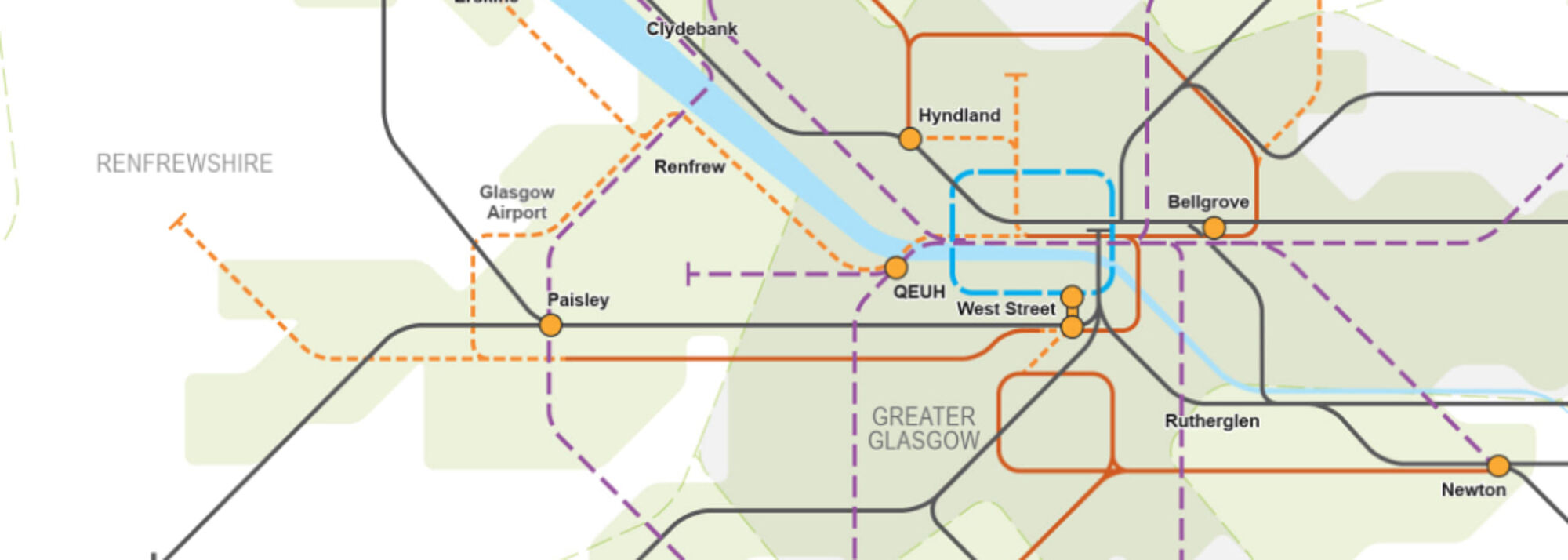
Aligning active travel and mass transit for the Clyde Metro Project in Glasgow.
About the Informing Clyde Metro Project
Glasgow has the most ambitious net zero goal in the UK, with a key priority being reducing emissions from transport. The Clyde Metro initiative is a key sustainable transport project supported by the Scottish Government and in alignment with national and regional transport strategies. Over a 30-year period, this multi-billion investment aims to improve connectivity for 1.5 million individuals in Glasgow, serving as a comprehensive and integrated public transport system, offering a sustainable alternative to private car usage.
The Clyde Metro is currently in the detailed planning phase, building the Case for Investment, presenting a timely opportunity to contribute to a scheme that will impact Glasgow communities and future generations.
The proposed project is centred around 5 interlinking objectives:
-
To identify what comparable cities or city regions have planned and implemented a mass-transit system and what learning can be applied to proposals for the Glasgow City Region.
-
To understand how other cities or city regions have integrated active travel infrastructure and mass-transit to enable safe multimodal journeys.
-
To explore experiences of active travel and public transport with those who face barriers to sustainable transport usage.
-
To summarise the published health economic evidence on the costs, health, and broader societal impact of mass-transit schemes.
- To develop a conceptual model that maps out the costs and benefits likely to arise from a regional mass-transit scheme such as Clyde Metro in both the short and long-term.
Background and Collaborations
This project builds upon and has synergies with activities within the GALLANT Active Travel team. It complements their work to improve health, wellbeing, social connectedness, and air quality, and reduce car journeys and carbon dioxide emissions. Currently, the Active Travel team is focused on walking, cycling, and wheeling, whereas the proposed project extends this focus to consider multi-modal mass transit.
This study is a collaboration between the University of Glasgow, Glasgow City Council and Glasgow Centre for Population Health that aims to inform the development of the Clyde Metro Case for Investment.
Members of the study team from the University of Glasgow are Dr Emma Lawlor (Project Principal Investigator), Dr Maria Bissett, Dr Manuela Deidda and Dr Samuel Owusu Achiaw. (can there be links to each of our profiles please?)
This study was awarded GALLANT Innovation Funding to strengthen internal partnerships (School of Cardiovascular and Metabolic Health and Health Economics and Health Technology Assessment Unit) and external partnerships with Glasgow City Council to respond to their sustainable transport policy priorities.
The Carnegie Trust for the Universities of Scotland Research Incentive Grant also supported the study (Trust reference: RIG013427).
Research and Activities Supporting the Future Development of Clyde Metro
The team have completed two new reports to support the development of the Clyde Metro Case for Investment. The research explores how future regional mass-transit systems can better connect with walking, wheeling and cycling infrastructure, improve accessibility, and deliver wider social, economic and health benefits for communities.
The study focused on three key areas:
- Aligning active travel infrastructure with mass transit
- Widening use of Clyde Metro and improving accessibility
- Understanding the wider benefits of investment in regional mass transit.
Report A explores lessons from international cities that have developed mass-transit systems alongside integrated active travel infrastructure to support safe and seamless multimodal journeys. The report also draws on interviews and photo elicitation activities with people across the Glasgow City Region who face barriers to using sustainable transport. Their experiences provide important insights into the challenges and opportunities associated with public transport and active travel.
Report B examines the health economic evidence relating to mass-transit systems and explores the potential short- and long-term costs and benefits associated with Clyde Metro.
Together, the reports provide evidence and recommendations to support the ongoing development of Clyde Metro and identify priorities for future research, policy and practice.
Links
- Find out more about Glasgow City Council's Clyde Metro Project
- Contact: Dr Emma Lawlor (emma.lawlor@gla.systa-s.com)